
 By snap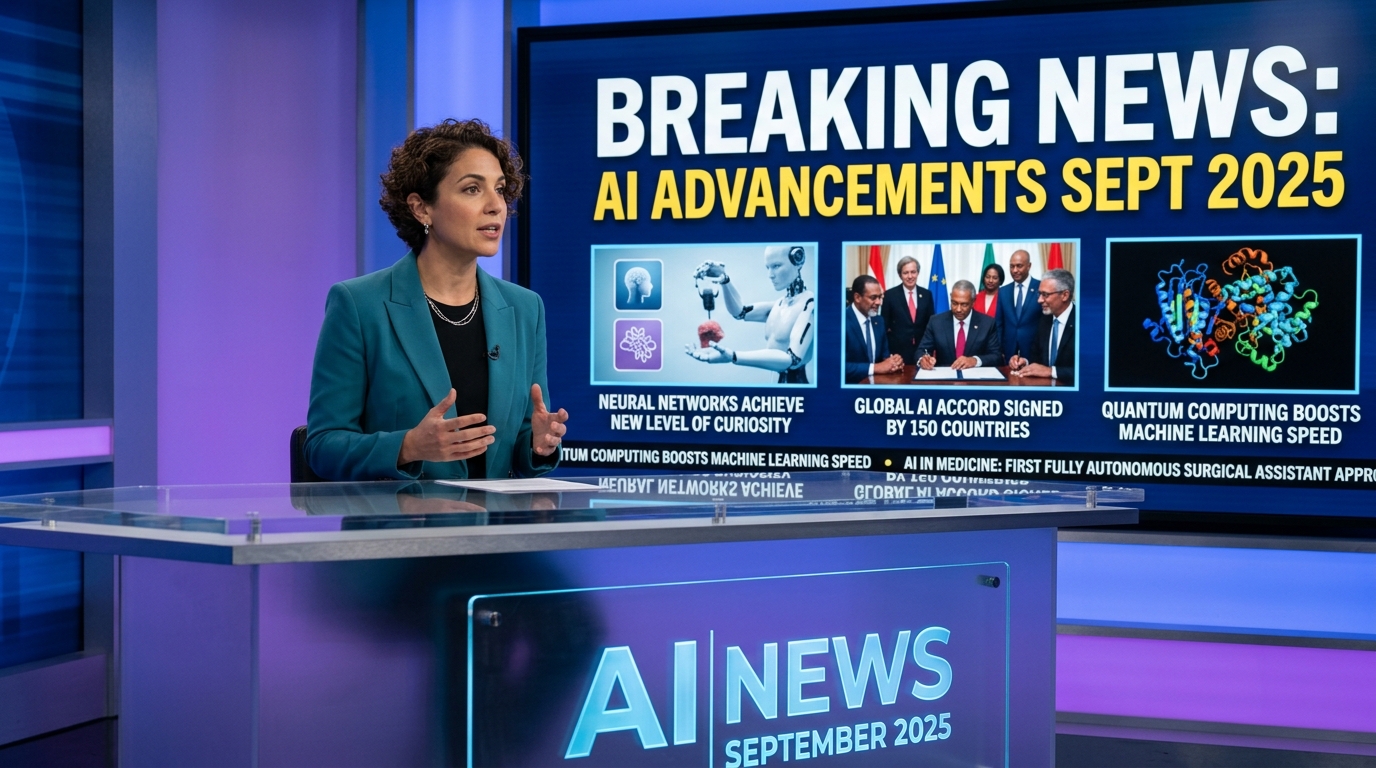
The latest AI news September 2025 delivered reveals a month defined by massive infrastructure spending, competitive model releases, and tightening regulation. Consequently, the artificial intelligence industry moved further into mainstream business and public policy conversations. Major companies announced billion-dollar deals, while governments introduced new rules governing AI development and deployment. Meanwhile, researchers published breakthroughs spanning reinforcement learning, robotics, and brain-inspired computing. This article walks through the key stories, explains why they matter, and highlights broader trends shaping the industry.
OpenAI’s Stargate Project Accelerates Data Center Buildout
OpenAI made significant infrastructure announcements throughout September, expanding its ambitious Stargate initiative considerably. The company revealed plans to build five new data center sites across the United States, partnering with Oracle and SoftBank on the effort. Specifically, three sites will rise in Shackelford County, Texas, Doña Ana County, New Mexico, and an undisclosed Midwest location. Additionally, the combined capacity from these new sites brought Stargate to nearly 7 gigawatts of planned capacity, alongside more than $400 billion in investment commitments. This aggressive timeline pushed the project ahead of its original schedule considerably. As a result, OpenAI positioned itself to secure its full $500 billion commitment before year’s end. Furthermore, OpenAI’s flagship Abilene, Texas campus already had its first two buildings operational by September, with NVIDIA GB200 AI racks delivered for early model training. Therefore, the physical infrastructure supporting future AI models moved from blueprint to reality remarkably fast. Industry observers noted the unprecedented construction pace involved in these deployments.
Oracle’s Cloud Business Surges on AI Infrastructure Demand
Oracle emerged as one of September’s biggest corporate winners within the artificial intelligence sector. The company’s stock soared 36% on September 11, following announcements of massive cloud computing contracts tied to AI demand. Consequently, a traditionally database-focused company transformed into a central player in AI infrastructure practically overnight. Moreover, Oracle revealed $455 billion in contracted revenue over the coming years, representing a fourfold increase from the previous year. This surge stemmed primarily from a massive cloud infrastructure deal signed with OpenAI. Additionally, Oracle projected its cloud infrastructure revenue would climb from $10 billion in the previous fiscal year to $144 billion by 2030. As a result, investors began viewing Oracle as a legitimate competitor in the cloud infrastructure race. Therefore, the September earnings and contract announcements reshaped perceptions of the company’s strategic direction entirely.
Alibaba Pushes China’s AI Ambitions Forward
While American companies dominated infrastructure headlines, Chinese firms made significant competitive moves during September. Alibaba released two major models: Qwen3-Max, a trillion-parameter system rivaling offerings from OpenAI and Google, alongside Qwen3-Omni, a real-time multimodal open-source model. Consequently, this dual release signaled China’s determination to compete directly in frontier AI development. Furthermore, the open-source nature of Qwen3-Omni distinguished it from many Western competitors’ closed systems. As a result, developers worldwide gained access to sophisticated multimodal capabilities without proprietary licensing restrictions. This move likely influenced how other companies approached open-source strategy going forward. Additionally, the trillion-parameter scale of Qwen3-Max demonstrated that Chinese labs could match Western computational ambitions. Therefore, September reinforced the reality that AI development has become genuinely global and competitive.
Meta Expands AI-Powered Content Curation
Social media platforms also embraced generative AI more deeply throughout September’s news cycle. Meta launched Vibes, a generative-powered short video feed rolling out to more than 40 countries. This platform personalizes content discovery, curation, and user engagement through artificial intelligence systems. Consequently, the boundary between human-created and AI-curated content continued blurring further. Moreover, this development suggested that future content ecosystems will rely heavily on algorithmic generation and curation. Therefore, questions about authenticity and creative ownership became increasingly relevant across social platforms. Meanwhile, critics raised concerns about how this shift might affect independent creators and traditional media producers.
Legal Battles Over AI Training Data Intensify
September also brought escalating legal challenges facing major technology companies over their training practices. Apple and other major tech firms faced intensifying legal action from publishers and authors, who accused them of using copyrighted content without permission. These lawsuits carry implications extending far beyond individual companies or specific legal disputes. Instead, they could redefine how data gets sourced and establish global precedents regarding fair use. Consequently, transparency in AI training data transformed from a technical concern into a pressing legal issue. Furthermore, publishers and authors argued that unauthorized data use undermined their intellectual property rights significantly. As a result, courts began grappling with questions that will shape AI development practices for years. Therefore, companies developing large language models faced growing pressure to disclose training data sources.
California Signs Sweeping New AI Regulation
State-level regulation also advanced considerably during September, with California leading significant policy changes. California’s governor signed a sweeping AI law requiring major developers to disclose safety protocols, report incidents, and protect whistleblowers. This legislation positioned California among the first states to mandate direct accountability from AI companies themselves. Moreover, this year alone, 38 states enacted approximately 100 AI regulations according to the National Conference of State Legislatures. Consequently, California resumed its traditional role as a technology regulation leader nationwide. Additionally, the governor had previously vetoed an earlier version of similar legislation before signing this one. Therefore, the final law reflected months of negotiation between lawmakers, industry representatives, and advocacy groups. As federal AI policy remained uncertain, states increasingly filled the regulatory gap independently.
Samsung Spotlights Vertical and Specialized AI Systems
Hardware and semiconductor companies also made notable announcements during September’s AI news cycle. Samsung hosted its AI Forum on September 15 and 16, bringing together leading researchers and industry figures. Furthermore, Samsung’s event spotlighted vertical AI, meaning tailored systems optimized for specific industries, alongside next-generation AI semiconductors. This focus suggested the industry moving beyond general-purpose models toward specialized, sector-specific applications. Consequently, companies increasingly recognized that targeted AI solutions often deliver better returns than broad general models. Additionally, Arm revealed breakthroughs in on-device AI designed for vehicles and data centers during this period. These low-latency, privacy-first chips target real-time multimodal assistants and edge-native applications specifically. Therefore, processing power continued moving away from centralized cloud systems toward local, embedded devices.
Research Breakthroughs in Reinforcement Learning and Robotics
Academic and industry researchers also published notable technical breakthroughs throughout September 2025. Improved reward modeling techniques gained attention in research surveys, addressing limitations large language models face in long-horizon tasks. Specifically, reinforcement learning boosted accuracy by 20 to 30 percent on benchmarks like GSM8K. Consequently, this improvement addressed a persistent weakness in how models handle multi-step reasoning problems. Moreover, applications for these techniques spanned agentic systems, workflow automation, game AI, and robotics simulation. Additionally, multimodal AI in robotics combined vision, language, and action models, enabling robots to interact more holistically with physical environments. Therefore, September’s research output suggested meaningful progress toward AI systems capable of sustained, complex reasoning. Enterprises increasingly demanded this reliability, with surveys indicating widespread productivity gains from AI adoption already.
Labor Market Impact Remains Uncertain, Studies Find
Despite widespread concern about AI’s effect on employment, September research offered a more nuanced picture. Studies from Yale University’s Budget Lab and the Brookings Institution found that while occupations are changing rapidly, this pattern predates AI’s introduction. Furthermore, researchers found no clear evidence that AI specifically drove the labor market changes observed so far. Co-author Martha Gimbel noted that despite examining the data many different ways, no clear AI-driven disruption emerged. Consequently, this research pushed back against widespread assumptions about AI already displacing significant portions of the workforce. However, researchers also acknowledged it remains too soon to see the technology’s true long-term employment effects. Therefore, the debate over AI and jobs continued without definitive resolution by month’s end.
Brain-Inspired Computing Models Show Promise
Beyond large language models, September also brought interesting developments in biologically-inspired computing approaches. Researchers demonstrated a model rivaling GPT-2 performance on language and translation tasks while remaining biologically plausible as a brain model. This system’s working memory relied entirely on synaptic plasticity, using Hebbian learning principles with spiking neurons. Consequently, individual synapses strengthened as they processed specific information patterns, mimicking biological neural function. This research direction offers an alternative path toward efficient, brain-like artificial intelligence systems. Moreover, such approaches could eventually reduce the massive computational resources current large language models require. Therefore, biologically-inspired computing represents a promising, if still early-stage, research direction worth monitoring closely.
Creative Industries Grapple With Generative AI Tools
Artists, filmmakers, and writers paid particularly close attention to AI developments throughout September 2025. Creative software tools reached a point where they could generate increasingly sophisticated visual and audio content. For some creators, this technology became an exciting tool for rapid experimentation and idea development. Others, however, worried considerably about copyright implications and questions of creative originality. If a machine produces a painting or song, questions about rightful ownership become genuinely complicated. Consequently, this debate became one of the most widely discussed topics within creative communities during September. Meanwhile, some platforms began developing frameworks to address attribution and compensation for AI-assisted creative work.
What These Developments Mean Going Forward
Taken together, September 2025 revealed an AI industry maturing rapidly while facing significant unresolved challenges. Infrastructure investment reached unprecedented scales, with companies committing hundreds of billions of dollars toward computing capacity. Meanwhile, regulatory frameworks began taking shape at the state level, filling gaps left by federal inaction. Legal battles over training data signaled that intellectual property questions will shape development practices considerably. Additionally, research breakthroughs in reasoning, robotics, and brain-inspired computing suggested continued technical progress beyond simple scaling. Rather than replacing human creativity or intelligence entirely, many experts believe the technology will augment human capabilities. Think of it as a bicycle for the mind, helping people accomplish more than they could alone. Ultimately, September 2025 demonstrated that AI conversations now extend far beyond laboratories and technology companies. Students, artists, business leaders, and everyday consumers all became active participants in these unfolding discussions.